· 4 min read
Maybe I'm Happy Like This
Originally written in Italian. This English version is an automatic translation and has not been reviewed: it may contain errors. Read the original
Benny had a dream. He was the manager of a small film agency that had grown a lot after the breakthrough of one of his clients, Shen, who had landed a big contract for an entire franchise based on a TV series, Professor Whom. Business was going well, and yet Benny’s dream was something else: to put aside enough money to change his life one day and move to Colorado to open an alpaca ranch. There, reconnecting with nature and looking after those animals that fascinated him so much, he would finally feel happy.
That, at least, was the plot of the Lesson 72 videos, which I had followed over the previous weeks on the English school’s website, before the exam. “Marco, what is Benny’s dream?” (in English, naturally). Then, all of a sudden, comes a harmless question, addressed to the whole class: “And what about you, what’s your dream?”. A girl answers that she would like to win an Oscar. She’s a performer by trade: she dances, sings, acts. An Oscar, wow. Fair enough. “And you, Marco, what’s your dream?”
I feel a bit like Novecento when they ask him why he has never got off the ship. On the spot I don’t know what to say, and I come across as a fool. “Well, I don’t know, I don’t think I’ve ever thought about it. Maybe… maybe I’m happy like this.” The fact is, I can’t get that question out of my head. I’ve been thinking about it for days. My dream. What is my dream? Is it possible that I don’t have one? Can you live without a dream?
What a dream is, I couldn’t say. Perhaps it is something we want for ourselves, a fixed star we set our sails by. Perhaps it is something we know we can’t reach, because if it came true it would stop being a dream. Or perhaps it is a small piece of happiness that one day we really will be able to grasp, as long as we don’t get lost along the way while we wait. And I don’t even know whether it’s right to have dreams: sometimes it seems to me a way of feeling sorry for yourself, thinking about what you don’t have (yet), only to not even notice it when it arrives.
Andy Dufresne had a dream too. Once out of prison, he would go to Zihuatanejo, in Mexico, on the Pacific, because the Pacific has no memory, and he had plenty of memories to leave behind. He had been sentenced to two life terms, to be served one after the other, for the murder of his wife and her lover, a murder he hadn’t committed. Two life sentences would be enough to snuff out anyone’s dreams. He, on the other hand, never let his go. For twenty years he built his escape, and when he finally got out, the dream was still there waiting for him: Zihuatanejo.
Thinking it over, though, I’m not sure a dream necessarily has to have the sharp outlines of a ranch in Colorado or a beach on the Pacific. Maybe it doesn’t even have to be romantic. Benny and Andy knew exactly where they wanted to go; I don’t, and for a few days I felt it as something missing. Then I began to suspect that the point lies in the way we imagine happiness. The happiness I have in mind today is not the same one I had at twenty, and it probably won’t be the one I’ll have in another twenty years. It changes with time, with the people we meet, with the situations we go through. And so it can happen that the road we take to chase a dream leads us somewhere else, to a place we hadn’t foreseen, where perhaps we discover that the dream, once reached, wouldn’t really have made us happy. Who knows whether Benny, after a few winters in Colorado among his alpacas, would have ended up missing the chaos of the agency.
Imagining a future happiness is a bit like arranging to meet in a place and at a time that may never exist. You risk spending your life waiting, always looking a little beyond where you are. Perhaps, then, you might as well settle for an almost-happiness: less bright, less defined, but closer to the moment we are in now. A happiness that promises nothing, but at least is here.
And perhaps a dream, sometimes, isn’t chosen in advance. You discover it afterwards, looking back, when you realise that all those steps, taken one at a time and often without really knowing why, were heading in a direction we could never have predicted. Perhaps someone without a dream isn’t empty. Perhaps they are already inside something they once dreamt of without knowing it.
If someone asked me that question again today, in class, I would probably answer the same way, with the same hesitation. Maybe I’m happy like this. Only now it wouldn’t feel like a non-answer any more. I don’t know if it’s true, just as I’m not sure of almost anything, but I’m beginning to think that this is fine too.
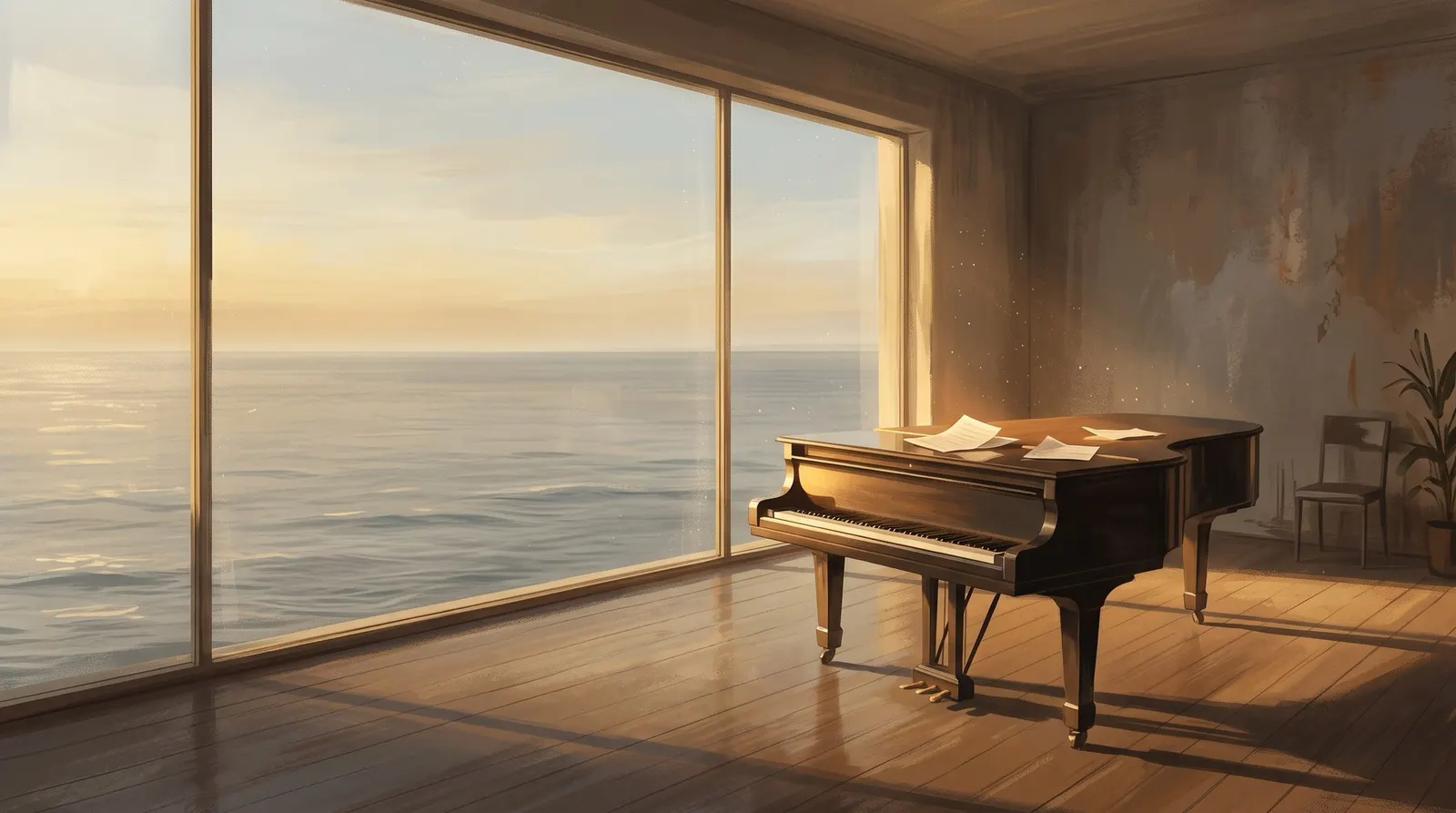
Novecento, after all, never got off that ship. Perhaps not because he didn’t have a dream, but because his, without anyone noticing, was already there, under his fingers, on a keyboard of eighty-eight keys.



Comments