· 9 min read
We're All a Little Bit Ted Lasso
Originally written in Italian. This English version is an automatic translation and has not been reviewed: it may contain errors. Read the original
Correction (16 November 2026). In an earlier version of this article I wrote that Guido Stratta “works on people and organisation at Enel”. That is no longer the case: he was head of people at the Enel Group from 2020 to 2023, then left the company of his own choice. My apologies to readers: I have corrected the text below.
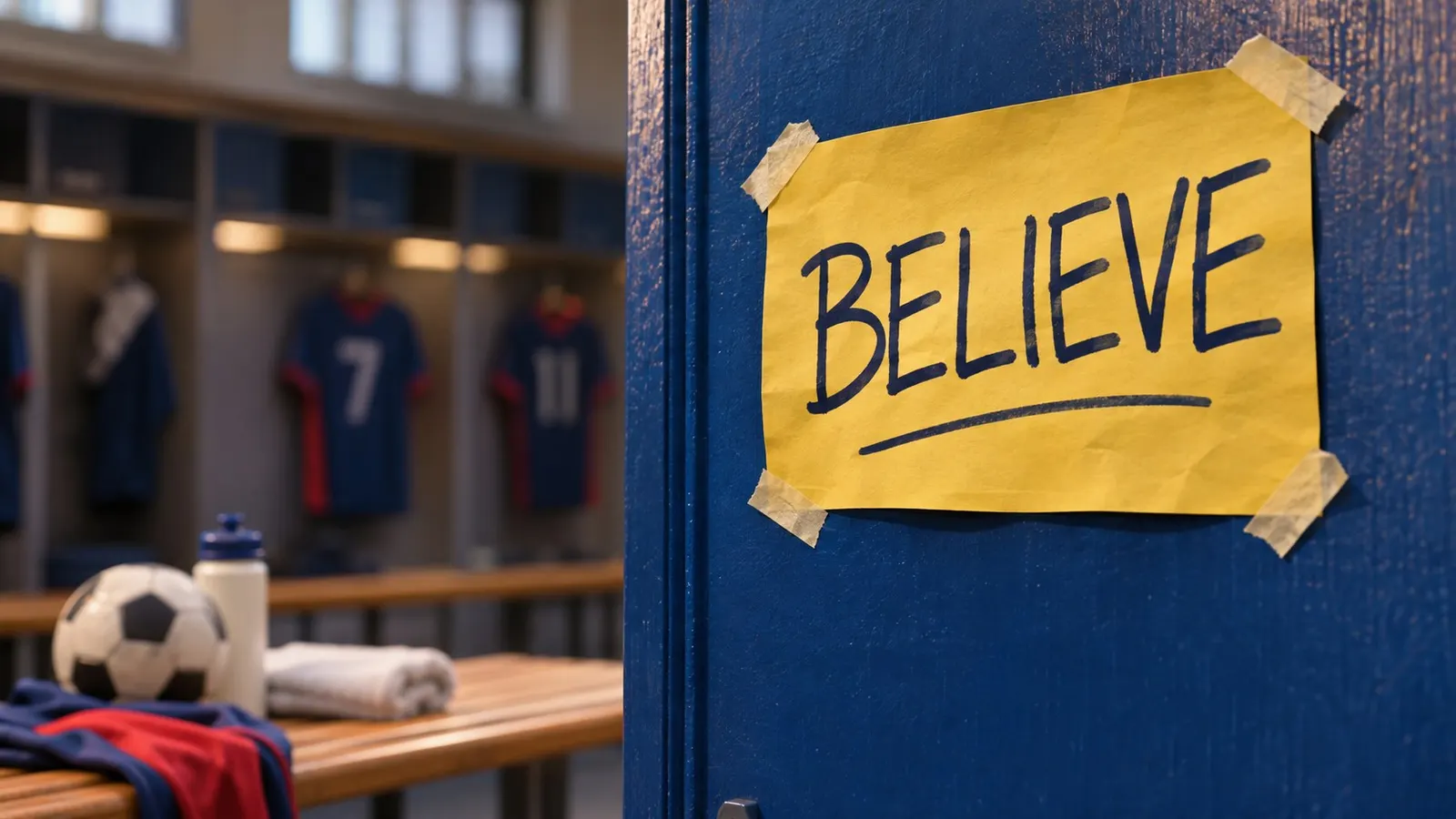
On his first day in the new locker room, Ted Lasso takes a sheet of yellow paper, writes a single word on it by hand, in capital letters, and tapes it above the door: BELIEVE. The players look at him the way you look at a tourist who has walked into the wrong stadium. Ted was an American football coach from Kansas, hired to manage an English football team without even knowing the offside rule. The owner, as we soon find out, chose him precisely for that reason: so that he would fail. He doesn’t know it. Every morning he shows up with a box of homemade biscuits for her, asks the name of the young kit man whom nobody ever greets, and starts asking questions.
The first time I saw that scene I smiled, the way you smile at a slightly naive character. What can someone who doesn’t even know the rules of the game teach a team of professionals? Then, episode after episode, I realised that the crooked sheet of paper above the door had stayed with me more than many of the leadership books I had read. It took me a while to understand why. Ted doesn’t walk into that locker room as a teacher. He walks in as a student, with far more questions than answers. And precisely because of that, little by little, the team begins to follow him.
Today we have a name for this way of leading: kind leadership. Guido Stratta, for years head of people at Enel and founder of the Academy of Kindness, sums it up in an idea I really like: looking at people not for who they are today, but for who they could become. Many articles, though, in order to convince us that kindness pays, list its advantages: more productivity, fewer absences, fewer people leaving. I don’t doubt it’s true. But if kindness becomes nothing more than a technique to make people work harder, it stops being kindness. And people usually notice.
Simon Sinek, who has been one of my points of reference for years, turns the perspective around. In one of his videos he observes that there are people at the top of organisations whom we obey because they have authority, but whom nobody would really follow; and people with no title at all whom others follow willingly, because they have chosen to look after those beside them. Rank gives you authority. Trust is something you have to earn. It’s no coincidence that his best-known book on leadership is called Leaders Eat Last. The title comes from an answer given by Marine Corps General George Flynn: in the mess hall, the most junior line up first and the most senior last. The point isn’t the queue, it’s what it stands for. The person who leads isn’t there to be in charge, but to take care of those entrusted to them; it isn’t people who serve the leader’s profit, it’s the leader who serves their dreams. When people feel protected by those who lead them, they stop watching their backs and start looking ahead, together. The results come, of course. But they come as a consequence, not as the goal. People often say that people don’t leave a job, they leave the person who leads them. The opposite is also true: they stay, sometimes against all convenience, beside the person who makes them feel seen.
In the first episode, Ted Lasso says something very similar to a journalist who asks him what success means to him: it isn’t about wins and losses, but about helping those young men become the best versions of themselves, on and off the pitch. Put like that, it sounds like a line from a greeting card. Then you see him at work, and you realise how exhausting it is.
Sinek often uses a comparison that I understand a little more every day: leading a team is a lot like being a parent. I remember a talk in which he said, more or less, that everyone wants to have children, but not everyone wants to raise them. The idea of having a child is wonderful, just like the idea of leading a team. Raising one is something else: sleepless nights, patience, hard choices, the effort of being there even when you don’t feel like it. Since becoming a dad, I know exactly what he means. Sinek then adds something else: there is no such thing as a perfect parent, and in the same way there are no experts in leadership. There are only people who keep learning. In leadership, as with children, you never graduate.
If leadership is a school you never leave, then the first lesson I learned from Ted Lasso is curiosity. In one of the best scenes of the series, Ted admits that all his life people have underestimated him, and that for years he wondered why. He found the answer in a phrase he happened to read on a wall, attributed to Walt Whitman (who, as it turns out, apparently never wrote it): “Be curious, not judgmental.” Those who underestimated him weren’t curious. They had already decided who Ted was, before asking him a single question.
Be curious, not judgmental. If I had to sum up in one line what I mean by leadership, I would probably choose this. Being curious about people means asking questions instead of taking the answers for granted, and finding out what they can do before deciding what they can’t. John Ternus, an engineer and now Apple’s CEO, gave the engineering graduates of the University of Pennsylvania a piece of advice that strikes me as the right balance: always assume you’re as smart as anyone else in the room, but never assume you know as much as they do. Never feel inferior to anyone, and never feel you have arrived.
The second lesson is believing in people, and I found it where I least expected it. I recently watched The Lego Movie, convinced it was a cartoon for children. Instead I found a story about power. The villain, Lord Business, wants to glue every brick in place forever, so that everything stays as it is and follows the instructions. The hero, Emmet, is an ordinary minifigure who discovers he is “the Special”. Only at the end do we learn that the prophecy was made up: he became special because someone told him he was, and he believed it. And when he faces the villain, he doesn’t defeat him by fighting. He tells him that he doesn’t have to be the bad guy, that he too is extraordinary, like everyone else. With plastic bricks, the film says the same thing as Ted’s yellow sheet of paper: people often become what someone believed they could become.
The third lesson is the hardest, because kindness has a shadow, and those who present it as a recipe for everything sometimes forget it. Kind doesn’t mean accommodating. It doesn’t mean avoiding conflict, always saying yes, letting things slide so as not to upset anyone. A new or insecure team needs clarity and boundaries above all, and sometimes a decision has to be made quickly and without a vote. Ted Lasso is no saint. He makes mistakes, he is afraid, at some point he has to admit that he needs help. But when a player needs to be told he’s behaving badly, Ted tells him, looking him in the eye. He doesn’t do it to show who’s in charge: he does it because he cares about him.
Being demanding, however, doesn’t mean using the stick. Experience, including what I’ve lived through myself, has taught me that when feedback lands like a blow, especially at the beginning, when there is no trust yet, the reaction is almost always the same: people close up, they stiffen, sometimes they deliberately do the opposite. Not because they’re right or wrong, but because they feel attacked, and those who feel attacked defend themselves instead of listening. Advice given to help someone grow, on the other hand, leaves a door open: it says what isn’t working, but it also says that you believe in the person receiving it. It’s the difference between correcting someone and walking alongside them. True kindness, after all, is this: being demanding with people because you believe in them.
A team, as I imagine it, is a place where you can disagree, even firmly, without anyone feeling in danger. Where someone who has just arrived can say “what if we tried it this way?” and find someone willing to listen. Where a mistake is information, not a fault to be hidden.
Building a place like that takes a quality that rarely appears on the lists: courage. Sinek considers it the most underrated quality in a leader, far more than charisma. You can be reserved and reflective and still be an excellent leader, but you can’t be one without the courage to bet on people and to do the right thing when it’s the hardest one. And then you need the humility to stay in school: to keep reading, comparing notes, making mistakes and trying again, knowing that the most important teachers are often the very people you are supposed to lead. I recognise myself a lot in this idea. Just as with engineering, here too I feel I can approach the model I have in mind only asymptotically: one step at a time, without ever quite getting there.
I have always thought that leadership isn’t a rank on your shoulder, but a way of being with others, and that it can be practised every day, in any role. Listening to the person who has just arrived. Giving credit to whoever truly deserves it. Explaining the why of things. Saying thank you. Asking one more question before judging. They are small things, and that is exactly why they are within everyone’s reach.
Now, perhaps, I understand why that yellow sheet of paper stayed with me. It wasn’t an order, nor a promise. It was an invitation, addressed first of all to those who didn’t believe yet. But it was also a reminder for the person who had put it up: a coach who didn’t know the rules of the game and who, precisely because of that, never stopped learning them. From that team, day after day, as on the very first day.
Perhaps, deep down, we’re all a little bit Ted Lasso. Sooner or later we all walk into a locker room whose rules we don’t know: a new job, a new team, a newborn child. And every time we can choose whether to pretend we already know everything, or to tape a sheet of paper above the door and start asking questions.
Further reading
- Leaders Eat Last, Simon Sinek — about the book
- How great leaders inspire action, Simon Sinek — ▶ video on TED
- What Makes a Leader Great?, Simon Sinek — ▶ video on YouTube
- Why good leaders make you feel safe, Simon Sinek — ▶ video on TED
- John Ternus’s commencement speech to the engineering graduates of the University of Pennsylvania (2024) — Fortune
- Ted Lasso, TV series (Apple TV+), season one: episode 1 and episode 8, “The Diamond Dogs”
- The Lego Movie, animated film (2014)
- La leadership gentile (“Kind leadership”, in Italian), Guido Stratta — Fondazione Bellisario
- Leadership gentile (“Kind leadership”, in Italian), Eva Martini and Alessandra Scomparin — KaleidoHub
- The 4 rules of the “good engineer”, Marco Moraschi — read the article
Comments