· 5 min read
If this isn't fake news
Originally written in Italian. This English version is an automatic translation and has not been reviewed: it may contain errors. Read the original
With the advent of the internet and social media we have witnessed an exponential spread and growth of so-called “fake news”. Luckily we still have “traditional” newspapers to save us from this tsunami of post-truth!
Are you convinced of that too? Did fake news not exist before the internet? Well, actually, the one about fake news is fake news in every sense. I won’t go into the subject in detail, since there are people far better qualified than me* on the topic, who have devoted their lives to studying the spread of false news and the mechanisms of communication. I’ll simply recount a “trivial” anecdote that can be taken as an example of a whole series of similar cases. Let’s begin.
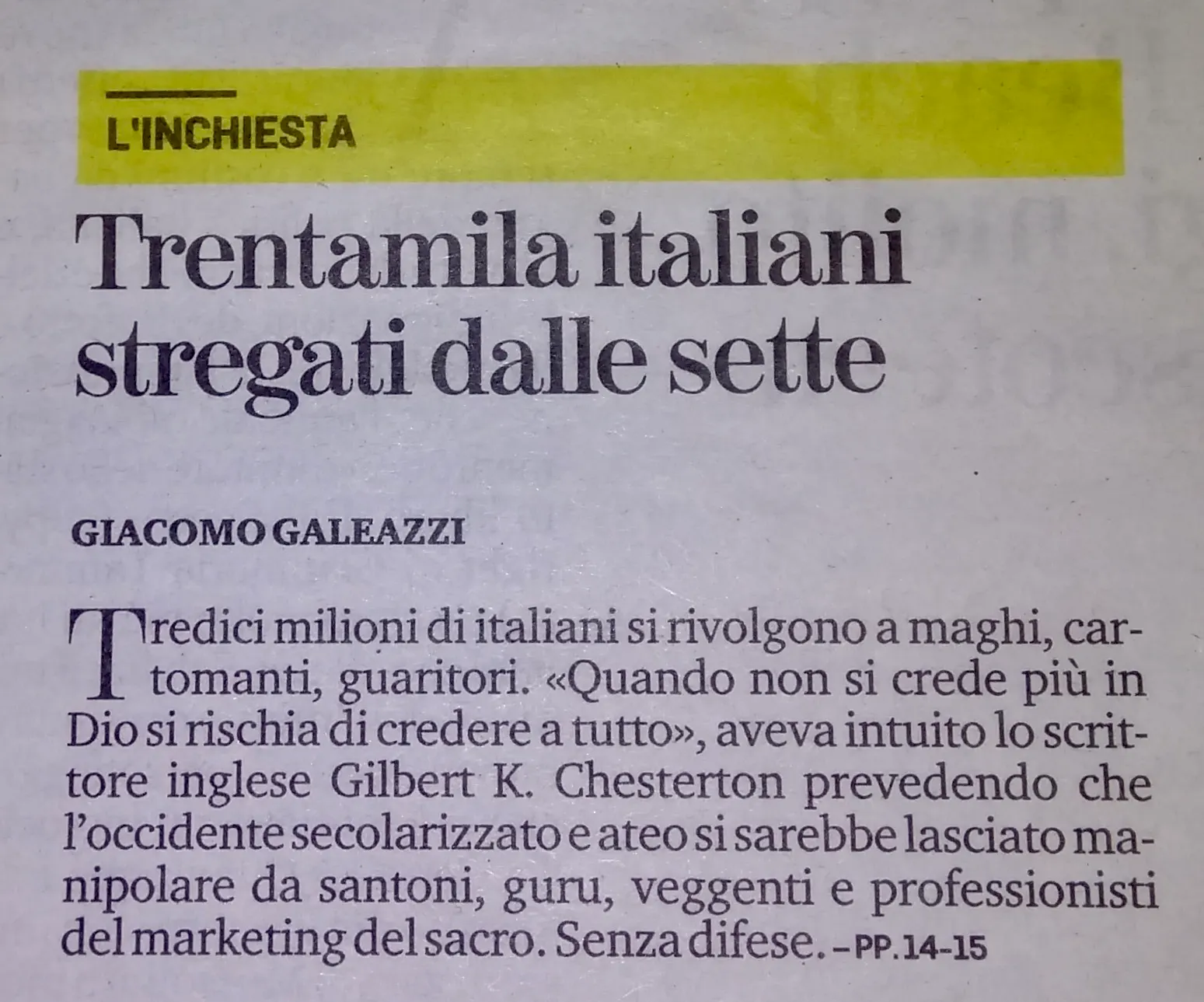
A few days ago (5 August 2019) I was reading the newspaper La Stampa, which, for better or worse, my family has always subscribed to. The front page carried a headline at the bottom: “Thirty thousand Italians bewitched by sects”. The subject interests me: although I’m an atheist, I’ve always found the dynamics that push people into the arms (or the jaws, it’s a matter of viewpoint) of religion curious. So I read the article. First sentence: “Thirteen million Italians turn to wizards, fortune-tellers and healers”. Thirteen million? Really? Can it be that 1 person in 5 in Italy turns to the occult to escape everyday problems? The number might not be especially striking, considering that radio and television still broadcast horoscopes and many people believe in miracles or wonders of other kinds. But come on, how many people do you know who go to a fortune-teller? Personally, not a single one, but that might simply be because we all tend to surround ourselves with people who think like us, excluding from our circles those who show “more bizarre” leanings. Somewhat struck, I start reading the rest of the article, even though I have a feeling I’ve heard this story before…
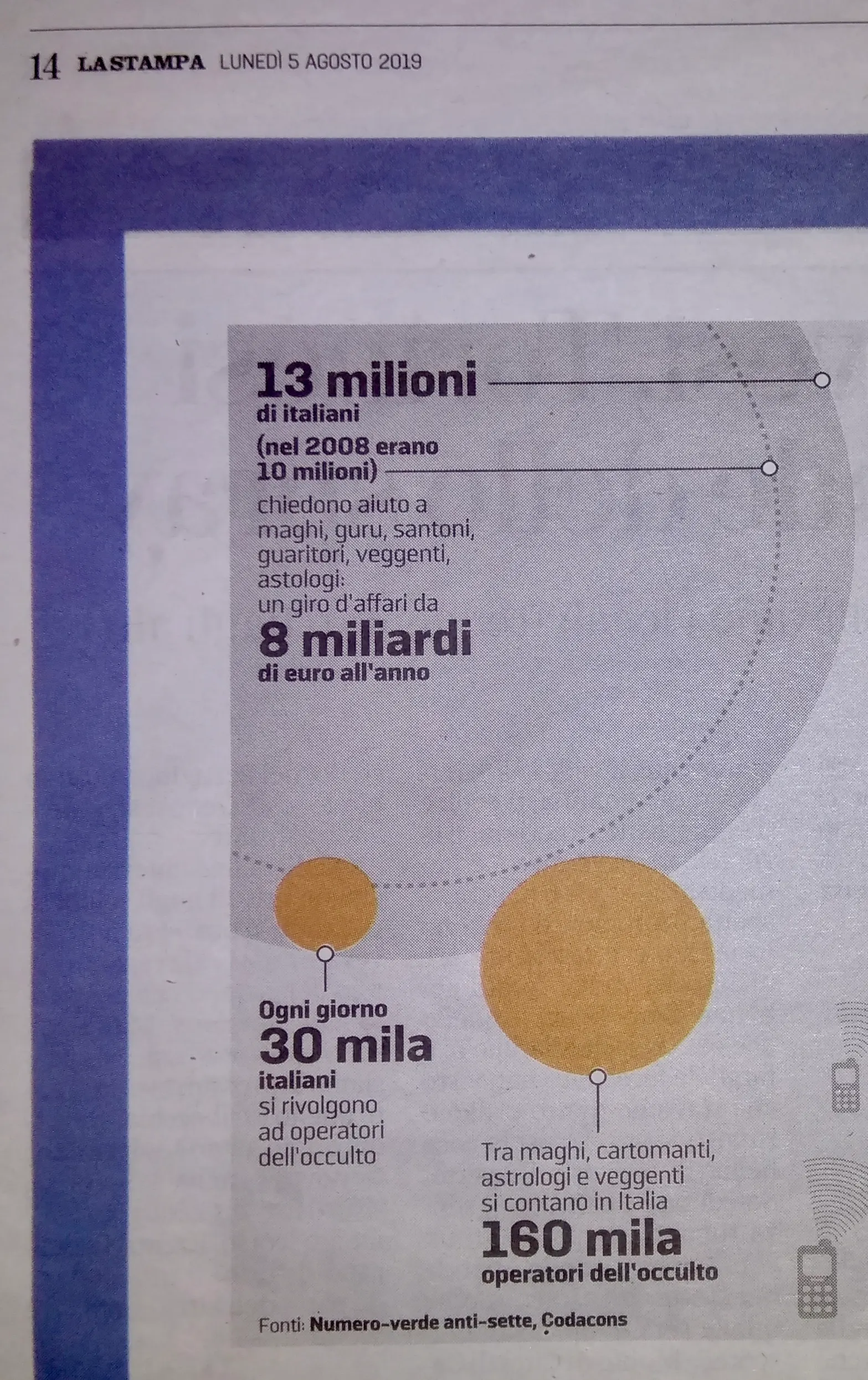
“There are 30,000 Italians (Codacons figures) who every day seek a consultation with wizards, astrologers and seers.” Stop right there! Did you say Codacons? A consumer association (Codacons is Italian), not a research institute. But let’s carry on; perhaps “La Stampa” gives some more precise figures on how Codacons came to say that 13 million Italians turn to wizards and fortune-tellers (and yet this news isn’t new to me…). “A turnover of 8 billion euros, according to a Codacons report on charlatans promising imaginary cures”. Codacons cited again, but of the studies carried out, not a trace. The article goes on to cite first the Children and Adolescents’ Ombudsman of the Calabria Region, then the story of Carolina (who had fallen into a sect’s trap), then yoga (eh?) and finally Zen Buddhism (!), just so we don’t miss out on anything. All this is set against the voice of a priest, who has surely fought sects during his life… but now I remember where I’ve read this article before! In a book by the Italian journalist Luca Sofri, editor of “Il Post” and author of “Notizie che non lo erano” (“News that wasn’t”), a collection of many of his articles from past years in which he describes the problems of Italian journalism, where “truth is not a priority; what counts is ‘the story’, the narrative, the ‘great piece’, fun to read”. On page 62, as luck would have it, there is an article entitled “Thirteen million”! The story had in fact already come out in Repubblica on 5 May 2014 (headline: “The great boom of the occult. 1 Italian in 5 goes to a fortune-teller”). The Repubblica article followed the same pattern as the one I have in my hands today, five years later: the figure quoted comes from Codacons, “which many times in the past has shown a greater aptitude for promoting itself and its leaders than for seriousness and truth” (Sofri’s words), and no research is cited explaining how that figure was collected. Reading on in Sofri’s piece, you discover that the same figure had already appeared in the previous weeks in other papers too: “Il Sole 24 Ore” and, as much as six months earlier, “il Fatto Quotidiano”. The Codacons figure, however, goes back to the year before that: “‘13 million in 2013’, it was said in May 2013, then with the wording ‘to date there are 13 million’, with no indication of a time span […]. Then in November it became ‘13 million every year’ and ‘three million more than in 2001’; in ‘Repubblica’, in May, ‘three million more than in 2010’”. The copy of “La Stampa” I’m holding states that there were “10 million in 2008” and, to add further mess to this string of random figures, cites the famous “thirty thousand Italians” who every day turn to practitioners of the occult (which ought to be 35,000 if you take the 13 million figure at face value, but evidently not even they believe it). Well, let’s come to the conclusions. Am I really subscribing to a newspaper to receive this kind of information? A piece of news from five years ago that wasn’t news even five years ago, and that in all this time they haven’t even taken the time to check?
I don’t know what you think at this point, but I’d say we’ve had enough. The big national papers, thrown into crisis by changing times, try to boost their sales by claiming that we shouldn’t trust what we read on social media (and therefore we must subscribe to their papers), but instead of really giving us different, quality information they repay us (often, not always, mind you) with the same clickbait articles we can already find everywhere on the internet. The truth is that fake news hasn’t increased with social media; information is probably the same as it was before, “it’s just that before, we didn’t notice: because in 1989 it took articles by other journalists and correspondents in Washington to let people know that an account was unfounded”. With the internet, on the other hand, it is much easier to find out whether a piece of news is true or not and, together with the fact that the amount of news reaching us every day has grown enormously compared with before, we therefore have the impression that there is much more fake news than before. I’ll close with a quotation from Luca Sofri and a piece of advice:
- “The point isn’t the mistakes, which happen: it’s that if you don’t pay attention they happen more often”
- Read Sofri’s book, “Notizie che non lo erano” (in Italian), because if good journalism in Italy has problems, it is partly our fault too.
*Walter Quattrociocchi, Craig Silverman, Luca Sofri, Massimo Mantellini, Massimo Polidoro, to name just a few.
Further reading
- Wittgenstein, Luca Sofri’s blog (in Italian)
- Il Post (in Italian)
Comments