· 6 min read
"Cosmos", reflections on the Universe from a pale blue dot
Originally written in Italian. This English version is an automatic translation and has not been reviewed: it may contain errors. Read the original
In 1980 the astronomer Carl Sagan presented a wonderful television programme called “Cosmos”, destined to leave its mark on the popularisation of science and astronomy. 34 years later, in 2014, the astrophysicist Neil deGrasse Tyson, Sagan’s own pupil and friend, presented a reboot, “Cosmos: A Spacetime Odyssey”, a 13-episode TV series of extraordinary beauty. After a whole 4 years, nuntio vobis gaudium magnum: I have finally watched the last episode too! In my partial defence I must confess that I actually only started watching this remake a few months ago, but the guilt remains: it still took me far too long. I can only recommend that everyone watch this little gem of popular science: the series is really well made, with animations, sets and topics aimed at touching the heart of the widest possible audience, not just nerds and astronomy enthusiasts. But I’m not writing these lines to review the TV series technically (that’s what they call them nowadays…) or to explain the scientific concepts it covers; there’s no need, and it really wouldn’t be appropriate. I’m writing because watching “Cosmos” stirred in me a great many positive emotions, of wonder and greatness, about science and about the human race, so brilliant with its mind, and yet so often so foolish.
The greatest astonishment for anyone approaching the world of astronomy for the first time is discovering how big the universe really is, so big that our brain can’t even imagine it. This discovery brings with it another realisation: man is a very small thing in cosmic space, indeed, truly insignificant, an infinitesimal crumb in the immensity of interstellar space. This upheaval of perspective, physical and philosophical, came about fairly recently, all things considered, in just the last 400 years of an evolutionary history spanning millions of years. It seems almost incredible, then, that we have managed a feat that is miraculous to say the least: we have managed to understand a little something about the universe we live in, not much to tell the truth, barely 5%, but from our smallness let me say it is still an extraordinary achievement. How did we do it?
In mythology, the first to soar into the sky for love of knowledge was Icarus with his wings of wax, whose sad end, however, we all remember. But let’s reassure ourselves straight away: it is, precisely, only a myth. In reality, the great step towards a change of perspective was also born about 400 years ago, with Galileo Galilei: it is called the scientific method. (Modern) science is what has allowed us to soar up towards the sky of knowledge, freeing ourselves from our earthly limits so as to fly on the wings of the mind. Neil deGrasse Tyson cites a few simple rules that helped scientists make this epoch-making leap:
- Challenge authority: no idea is right just because someone says so.
- Think for yourself. You need to question yourself to check whether one of your beliefs is true, or to discover instead that it is wrong.
- Don’t believe something just because it suits you. Believing in a theory doesn’t make it true, even if it may give us joy or relief.
- Test ideas against the evidence gathered from observation and experiment. If one of our theories fails a well-designed test, it is wrong: let’s forget it. You have to follow the evidence wherever it leads, and if there is none, you must reserve judgement.
- But above all, let’s remember that we can all be wrong. Even the best scientists have been wrong: Newton, Einstein and every other great genius in history made mistakes, and that’s as it should be: we are human.
Science is a way of not deceiving others or ourselves. So will following science always lead us to good? No: science is a tool for understanding the world, and like any tool it can be used for good or not. So let’s follow the advice of Tyson (not Mike…): “Of course, we have misused science, just as we have misused every other tool at our disposal, and that is why it must not be left in the hands of a narrow circle of the powerful. The more it becomes part of our lives, the less likely it is that anyone will abuse it.”
On 5 September 1977 the Voyager 1 mission left NASA’s base at Cape Canaveral, with the aim of exploring the most remote regions of the Solar System. 13 years later, at Carl Sagan’s suggestion, NASA commanded Voyager 1 to turn round and take one last photo of its home, Planet Earth. That photo has gone down in history as the “Pale Blue Dot” and is one of the most moving and extraordinary astronomical images of all time.
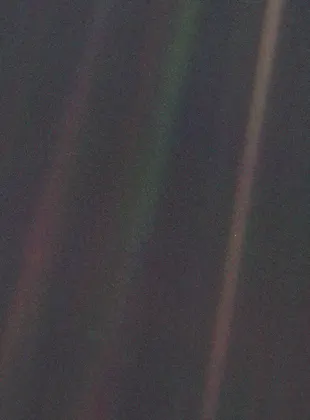
In 1994 Carl Sagan published the book “Pale Blue Dot: A Vision of the Human Future in Space”, in which he included his own heartfelt commentary on that incredible image. I don’t think you will ever read anything more inspiring. Man’s capacity to create, to love, to unite, when brought together for a greater purpose, can light up even the deepest darkness.
Carl Sagan:
«Seen from this far-off vantage point, the Earth may not appear to be of any special interest. But for us it is different. Look at that dot once more. It is here. It is home. It is us. On it, everyone you love, everyone you know, everyone you have ever heard of, every human being who has ever existed, has lived out their life. All our joys and sorrows put together, thousands of religions, ideologies and economic doctrines, each so sure of itself, every hunter and gatherer, every hero and coward, every builder and wrecker of civilisations, every king and commoner, every young couple in love, every mother and father, every hopeful child, inventor and explorer, every preacher of morals, every corrupt politician, every “superstar”, every “supreme commander”, every saint and sinner in the history of our species lived there, on a minuscule grain of dust hanging in a ray of sunlight. The Earth is a tiny stage in a vast cosmic arena.
Think of the rivers of blood shed by all those generals and emperors so that, in glory and triumph, they might for a moment become masters of a fraction of a dot. Think of the endless cruelties inflicted by the inhabitants of one corner of this pixel on the barely distinguishable inhabitants of some other corner, how frequent their misunderstandings, how eager they are to kill one another, how fervent their hatred. Our showing off, our imagined self-importance, the illusion that we hold some privileged position in the Universe, are called into question by this point of pale light. Our planet is a lonely speck in the great, enveloping cosmic darkness. In our obscurity, in all this vastness, there is no sign that help could come from somewhere else to save us from ourselves.
The Earth is the only world known to be able to host life. There is nowhere else, at least in the near future, to which our species could migrate. Visit, yes. Colonise, not yet. Like it or not, for the moment the Earth is where we play our cards. It has been said that astronomy is an experience of humility and that it builds character. There is perhaps no better demonstration of the folly of human vanities than this distant image of our tiny world. To me, it underlines our responsibility to look after one another more kindly, and to preserve and protect the pale blue dot, the only home we have ever known.»
Enjoy the change of perspective.
P.S. Did you manage to find the Earth in the picture?



Comments